
The unsexy traits of Strategic Brand Designers
I am not the best designer.
In fact, I am a self-proclaimed mid-level designer.
I haven’t won any big awards for designing, nor do I spend all my time:
learning Illustrator hacks,
studying color theory,
perfecting my typography,
following every design trend,
or collecting certificates.
Don’t get me wrong, I LOVE design.
In fact I really enjoy re-doing my old designs, learning from my mistakes, and working on new client projects! But if you asked me what got me where I am today, I’d say my design skills contribute about 30% to my success.
And it honestly wasn’t even the hardest thing I needed to work on.
As time passed, I’ve realised that there were some specific traits, which I’ve also noticed in other successful designers and business owners, that I had to master in order to build a business that I was proud of.
And no one talked about these, at least not when I needed to hear them.
So, if you’ve been focussing too much on improving your design skills for a while, yet you still feel stuck figuring out the solutions to the same problems, this is for you.
By the end of this newsletter, you'll understand why you've been stuck despite being talented, and exactly which traits to develop if you want to “become the person who runs a thriving design business.”
Because…
Most designers pour all their energy into the wrong things
It’s so easy to spot these designers who are perpetually busy but never actually moving forward.
They chase every new skill, tool, and trend
One week they're learning motion graphics. The next week it's 3D rendering. Then UX design catches their eye. Oh wait, now everyone's talking about AI tools, better master those too.
They accumulate skills like Pokemon cards, convinced that the next certification or software mastery will finally be the thing that transforms their business.
But while they're bouncing between tutorials, their portfolio stays half-finished. Their client pipeline stays dry. Their revenue stays exactly the same.
They start everything, finish nothing
Their hard drive is a graveyard of abandoned projects.
That passion project that they were excited about a few weeks ago now sits at 70% completion. The case study they started writing three months ago is still a “work in progress”. And they keep thinking about “that new service offering” that will finally help them increase their prices… lost somewhere in their endless list of "someday" ideas.
They get that initial dopamine hit from starting something new, but when it comes time to push through the messy middle and actually ship… they're already distracted by the next shiny opportunity.
They believe their work should speak for itself
This might be the most dangerous delusion of all.
They pour their soul into creating beautiful designs, then sit back and wait for clients to magically discover them. When that doesn't happen, they assume they need to make their work even better.
So they retreat back to their computer. More tutorials. More practice. More perfecting work that nobody's seeing.
Meanwhile, designers with half their talent are booking clients left and right because they understand something fundamental: great work that nobody knows about might as well not exist.
But Strategic Brand designers understand that:
Your business is only as strong as its weakest link.
Think of your design business like a pipeline.
You might have world-class design skills (a massive pipe at one end), but if your ability to manage client relationships is weak (a tiny pipe in the middle), your entire flow is restricted.
Most designers keep widening the pipes that are already huge (their design skills) while ignoring the tiny pipes that are actually constraining their success. They're essentially decorating a house with a crumbling foundation.
When you're not working on your actual bottleneck, you create the illusion of progress without real results. You feel busy. You feel productive. But month after month, year after year, nothing actually changes.
The bottlenecks holding most designers back have nothing to do with design.
They're the unglamorous, unsexy traits that nobody wants to develop.
These are, what I’ve seen as common traits among all thriving designers and business owners.
So instead of a framework, today I want to give you these traits, and what they look like in practice, so that every time you face challenges, you know what it means to show up as a thriving Strategic Brand Designer:
Trait #1: Emotional Intelligence (not emotional reactions)
Generic designers let their emotions drive their business decisions.
They take client feedback personally.
They spiral if their Proposal gets rejected.
They avoid difficult conversation until it explodes.
Strategic Brand Designers understand that business is emotional, but success requires managing those emotions, not being managed by them.
They've learned to separate their identity from their work. When a client says "I don't like this direction," they hear valuable information, not personal attack. When fear shows up before a big pitch, they acknowledge it and proceed anyway.
Being able to act despite your emotions is the only thing that lets you navigate the inevitable ups and downs without letting them derail your progress.
Trait #2: Curiosity and Continuous Improvement
Generic designers stop learning once they feel "good enough."
They master the basics, figure out a formula that works, and then repeat it endlessly.
Strategic Brand Designers are perpetually curious.
They question their own assumptions. They study work they don't like to understand why it resonates with others. They ask clients follow-up questions even when they think they already know the answer.
When a project doesn't land well, they don't get defensive. They get curious. They dig into why. They extract lessons. They adjust.
They understand that every client conversation, every project, every failure is data. And they're obsessed with collecting that data and getting better because of it.
Trait #3: Self-Discipline, not motivation
Most designers need the perfect conditions to start the work: the right mood, enough energy, a cleared schedule, the ideal workspace.
If they don't feel motivated, they don't show up.
Strategic Brand Designers show up even, nay especially when they don't feel like it.
They understand that motivation is unreliable.
They don't wait for Monday to start. They don't need a perfectly designed morning routine. They don't require inspiration to strike. They've built systems and habits that carry them through the days when everything feels hard.
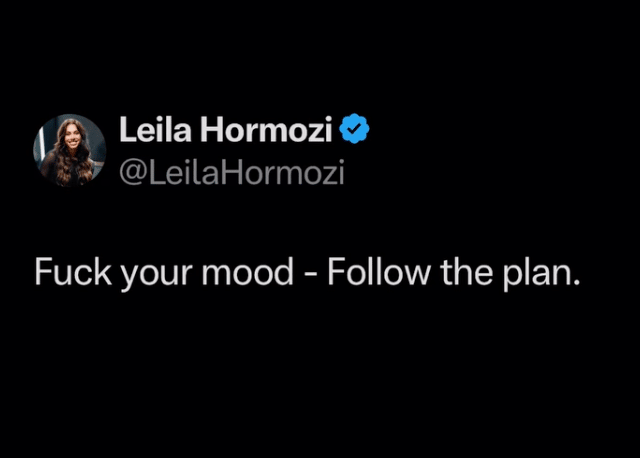
Because they know that discipline is doing what needs to be done, regardless of how you feel about doing it. And over time, that discipline compounds into results that "motivated" designers never achieve.
I love how Leila Hormozi explains this in one sentence:
Trait #4: Rapid Adaptability
In order to keep up and keep evolving, Strategic Brand Designers understand the need to stay flexible without losing their standards.
They adapt to the new ways of the world.
They don’t sit and complain how hard it is that Instagram changed it’s algorithm, or that AI bots have flushed people’s inbox making it harder to send emails that capture someone’s attention, or that there are too many matcha brands and it’s nearly impossible to make one stand out!
They problem-solve.
When new changes occur, which they always will, they assess whether they're worth adopting. When their usual approach isn't working, they try something different.
They have principles they won't compromise on, but they're endlessly creative about how they apply those principles to different situations.
Trait #5: Being Organised
Okay, this one’s 100% an underrated trait.
There’s one thing to look at organisation porn on TikTok and clean your closet, and a whole other thing to have systems and processes to manage your projects so you’re not working from scattered notes and half-remembered conversations.
I, for one, have systems for everything: client onboarding, project management, file organisation, follow-ups. Not because I love admin work (nobody does), but because I know disorganisation creates problems that waste time and damage trust.
And that’s what I see all other successful designers do as well.
They've automated what can be automated. They've templated what can be templated. They've built systems that let them focus their creative energy on actual creative work, instead of constantly firefighting problems caused by disorganisation.
Side note: If you'd like to "download" my systems into your business without having to create them from scratch, check out Strategic Designer OS. |
Because you know what is being sexy as Strategic Brand Designer?
Never missing a deadline. Never scrambling. Never making clients repeat themselves because you lost track of what they said.
If you read through these traits and felt a little uncomfortable, good.
That means you're being honest with yourself about where you actually need to grow.
Most designers avoid this kind of honesty. They'd rather believe they just need to get better at design, because that's more comfortable than admitting they need to work on discipline, or organisation, or emotional regulation.
But now you know better.
And the good news is that you can develop these skills starting TODAY. They just require something most designers aren't willing to give: consistent, uncomfortable effort in areas that don't feel immediately rewarding.
But if you can get comfortable with delayed rewards, trust me, you can win at anything.
Chat soon,
Abi 😊
How I can help you ⬇️
The Ultimate Operating System for Brand Designers ➡️ If you're ready to save hours on admin work, start confidently taking on more projects, and deliver consistently professional results, these proven templates and systems are your answer. |


Comments