
Want to see my old project receipts?
I found my old “Client Spreadsheet” last week:

That’s my project tracker from June 2020.
For anyone who found me recently and thinks I just land 4 and 5-figure projects like it’s nobody’s business, I hope this gives you a bird-eye view of where I started.
I was taking 30+ jobs in a single month that year!
And it wasn’t “Strategic Brand Identity”.
Hell no!
It was a mix of logos for £5, random print jobs, business cards, social graphics, loyalty cards, price lists, etc. And my goodness, I managed these all via email and Instagram DMs.
I have no idea how I got through it.
If you don’t already know, I got furloughed when COVID hit, and that was when I started freelancing. Once things settled down a little bit, I was called back into work. But by then, I had already taken up many client projects.
At the time, my days looked something like this:
5am–8am: Freelance
9am–5pm: Full-time graphic design job
6pm–9pm: Freelance again
There were nights where I’d finish my 9-5, open my laptop again and feel drained before I’d started.
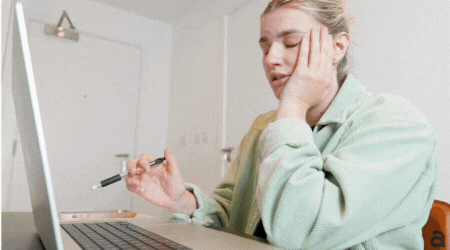
I knew keeping my word was super important as a freelancer
Because these were clients who trusted me and I’d promised them deadlines.
I couldn’t afford to build a bad rep, so I was fitting client work into every gap I could find, rushing jobs because the window to get them done was so narrow, and managing every single project out of my inbox and DMs.
I called it my "messy period", and that's exactly what it was.
I was not “onboarding” a client,
didn’t have clear way to receive feedback,
took briefs through emails & Instagram voice notes, and
kept track of deadlines in my head and hoped I didn't drop anything.
Sure, the work got done, but I knew that I was operating on borrowed time.
Even when I was in the middle of it all, too busy to zoom out and think things through, I could see that I needed to take a step back. ASAP. We all get 24 hours, and I was working for 16. Every. Single. Day.
It was a clear trap.
I thought I’d quit my job when I made more money, but to make more money I had to take on more projects, but I could not take on more projects because I also had a full time job!

I felt stuck until I realised where I was going wrong.
You see, there’s a ceiling to how many hours you can add to your work. And I was getting closer to it every week. Either way, I knew I had to quit. And I did. But it wasn’t so I could “gain more hours in the day.”
Quitting my job gave me the headspace to think.
For the first time in years, I could actually slow down and look at how I was running things, instead of just reacting to whatever landed next.
That period is when things started to get clearer.
Even in retrospect, I can see that it wasn’t down to one thing.
It was a mix of rethinking what I was offering, showing up online more consistently, learning more about strategy, getting better at the work, building proper structure and systems. It all happened together, gradually, over years.
But before I built anything, I had to figure out what to STOP doing first.
Two habits in particular were quietly eating up a huge chunk of my time.
The first was print jobs.
In the early days, I used to organise small print runs for clients, going back and forth with printers, correcting specs, chasing delivery issues, fixing files that weren’t set up right. It could eat an entire afternoon.
And at the end of all that back and forth, I’d sometimes make a couple of pounds in margin on the actual print cost.
It became one of those things where the admin and stress massively outweighed the actual return.
I also realised I didn’t feel creatively fulfilled doing a lot of those smaller graphic design tasks either. Some clients didn’t really have strong branding or direction, so I felt like I was just making things look good instead of doing work that actually made a difference.
Cutting it felt like a risk at the time, and I worried it would cost me clients.
Looking back, it was one of the clearest decisions I’ve ever made, and it pointed me naturally toward brand design, where I actually wanted to be.
The other habit I had to break was chasing 100% on everything.
I used to spend hours pushing work to a point where, honestly, 80% of the way there would have served the client just as well. There’s a version of thoroughness that genuinely adds value, and then there’s the version where you’re pouring time into something that’s mostly done.
I was doing a lot of the latter.
Once I had the space to think…
… I realised one of the first things I needed was a SINGLE place to manage all my projects.
That’s how I moved from juggling DMs, Whatsapp, and Emails, to my Client Portal & Project Tracker Hub: a Notion hub I set up so that everything for a project lived in one place.

The first time I used this hub, it was like a weight off my shoulders. The project ran without me having to chase anything, re-explain a brief, or manually manage a single step, and I felt it immediately.
That client portal is now a core part of the Strategic Designer OS, the operating system I use to run my entire design business today. But at the time, it was just one small thing I built when I finally had the room to think.
And that’s the thing I keep coming back to when I look at that 2020 spreadsheet.
Everyone keeps talking about “working harder”.
But simply working harder doesn’t fix a structural problem. In fact, it just delays it.
I needed to carve out the time to stop reacting and start designing how I work, not just what I deliver.
It took leaving my job to give me that space.
You might not need to go that far, but you do need to find it somewhere.
If you’re managing projects out of your inbox, keeping track of deadlines in your head, and constantly feeling like you’re a step behind, it is a signal that something needs to change. And it could start with the Strategic Designer OS, as it did for 8000+ designers:


Talk soon.
Abi 😊
PS. I still can't believe I was charging £5 for a logo. If you're doing the same, please raise your prices. Right now. Even if you’re JUST getting started. Seriously.


Comments